

[Starting a project] without the audience in mind is like writing a love letter and addressing it to ‘whom it may concern.’” — Ken Hamer, AT&T Research Manager
Okay, before we begin today’s post, I need to make a confession: I am not entirely sure Step 1 of the PM Blueprint is actually Step 1. I’ve wrestled with this for a long time. Sure, in the last post (here) I argued that establishing project goals and expectations is the very first thing every project manager needs to do. And I stand by that. But I can also argue, just as convincingly, that identifying key project stakeholders should come first.
Why do I struggle with this? Well, you can’t ask “why” the project is needed without talking to the people who’d provide the answers. The first two steps aren’t sequential at all. They kind of happen at the same time.
There is no easy way to show this in a simple diagram without looping arrows and confusion, so I’m inventing an easy way out: let’s leave Step 1 where it is, and put this second step of identifying stakeholders as number two—but recognize that these two things actually take place in parallel.
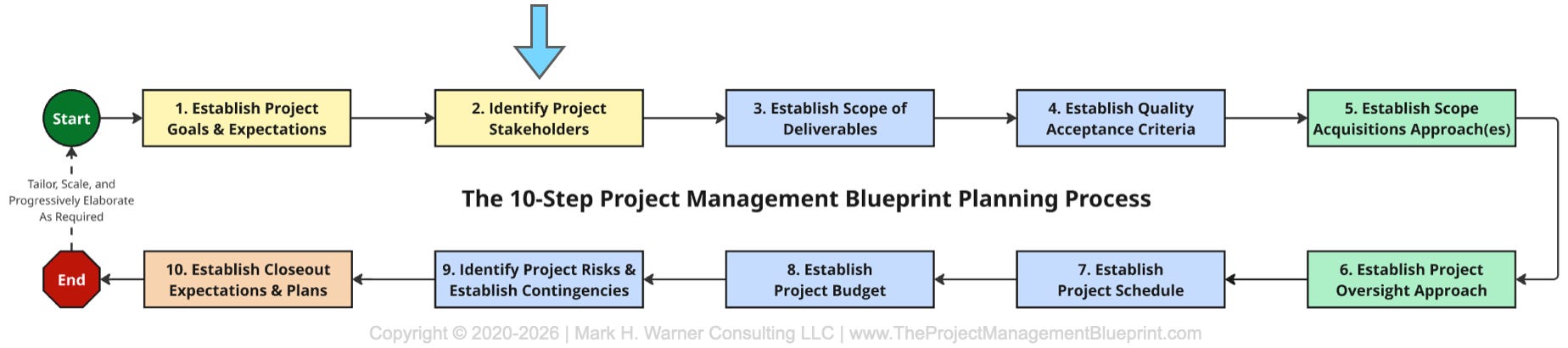
Okay, that said, I want to talk about why identifying stakeholders is so important early in a project. Here are six primary reasons you need to take this step seriously:
Every project has a “who.” Someone wants it, needs it, and/or is paying for it. These are your key stakeholders. Like Ken Hamer alluded to in the quote above, you must identify the “who’s” if you want to plan and execute a project that meets their needs.
Step 1 requires people to be interviewed. You can’t capture goals and expectations without knowing who to ask; this is why the two steps really form one initiation step. You must also separate key stakeholders (i.e., high interest, high influence, & pro-project entities) from everyone else, because it tells you whose definition of success governs when conflict occurs.
Buy-in starts with stakeholders. Identifying key stakeholders is where buy-in starts. It’s the first step to forming a win-win partnership. People called out and consulted early feel ownership, and the stakeholder register becomes your list of who helps guide the project and reviews & approves each progressive-elaboration pass.
Requirements live in people’s heads; your job is to extract those thoughts. Establishing scope and acceptance criteria (PMB Steps 3 and 4) come from the mission statement and from your stakeholders. The stakeholder register also drives the org chart, RACI, and communications plan. Miss an important stakeholder, and you risk missing both requirements and roles.
Success is measured both objectively and subjectively. At the end of the day, project success is objectively determined by whether you delivered all the scope on time, on budget, and it met all of its quality acceptance criteria. But there is another, equally important measure of success: stakeholder satisfaction. Subjectively-speaking, are your stakeholders pleased with how the project was carried out and communicated to them? Are they happy with how involved they felt? You can hit every traditional performance measurement baseline metric and still have an unhappy stakeholder, who considers the project a failure because they weren’t engaged with. Establishing who matters from day one is key to satisfying them.
Surprise stakeholders are expensive. Changes are cheap on paper and costly in hardware. Decisions are also cheap early and expensive later. Build something and then discover a key stakeholder? That’s a real problem. Some surprises can also be worse than just expensive: regulators, permitting offices, and community groups can hold outright veto power.
The people who accept the deliverable are the ones you identified. Closeout sign-off (PMB Step 10) can only happen if you know who has the authority to give it.
Look, whether we put Identify Stakeholders before or after the Establish Goals and Expectations step, you can’t deny its importance. Get the “who” wrong, and everything else, from the requirements, to the schedule, to the sign-off at the end, will be built on a guesses and hopes. Bottom line: you cannot write a love letter unless you know who it’s going to.