

“The first thing I’ll ask a struggling project manager is to show me their Work Breakdown Structure.”
— Bill McVeigh, Dash360.com
We’ve covered the Who and the Why in steps 1 and 2, respectively. Now it’s time for the project’s What.
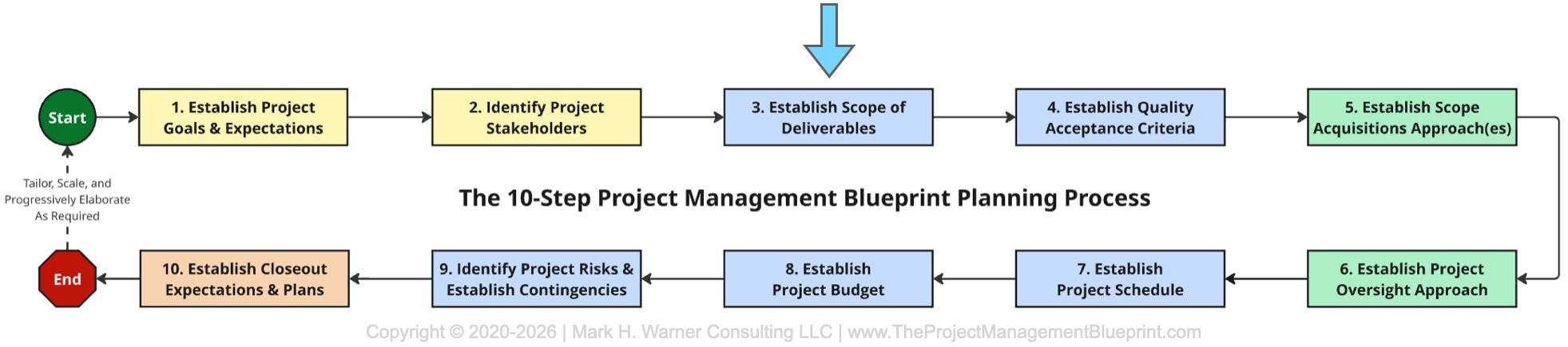
Step 3 is when we name every product, service, and result the project has to create or provide. There’s nothing fancy about the output, which we call a Work Breakdown Structure. A WBS is just a list of the deliverables in a hierarchical order. An accompanying document called the WBS Dictionary describes what each one of these deliverables actually means. Together, they answer “what are we building?” in a way nobody should be able to argue with later. Here’s why that has to happen now, in Step 3, and not sooner nor later:
It turns a purpose into a thing. “Improve solar imaging” isn’t buildable. “A 4-meter telescope with X instruments” is. The WBS is where abstract goals and intent become a concrete list of deliverables.
It draws the boundary of what’s in, and just as importantly, what’s out. Without a defined boundary, everyone assumes their own version of “included.” This is the first real defense against scope creep, before there’s even a schedule or budget to protect.
It creates a shared vocabulary. The WBS Dictionary defines what each element actually means, so “the enclosure” or “the control system” means the same thing to the engineer, the contracts officer, and the stakeholder.
Everything downstream is organized around the WBS. Schedule activities, budget line items, risk register entries, acceptance criteria, and acquisition strategy are all typically structured by WBS elements. You can’t decide how good something has to be (Step 4), how to acquire it (Step 5), what it’ll cost (Step 8), or what could go wrong with it (Step 9) until it has a name and a place in the breakdown.
It builds on stakeholder engagement. The mission statement and charter initiate stakeholder engagement. The WBS is the next genuine opportunity to keep the stakeholders leaning in as active participants: it’s concrete enough that people say “wait, that’s missing” or “we don’t need that.” This is both progressive elaboration and active stakeholder engagement in action.
It’s what gets checked off at closeout. Final delivery is measured against the WBS. If it isn’t on the list, it isn’t a deliverable; the WBS is literally the scorecard.
Bill’s right in the quote above. Show me your WBS, and I’ll tell you how your project’s going.