

As I wrote earlier (here), planning any project should involve the same 10 Blueprint questions, whether that project is a DIY garden shed or a federally funded solar observatory. What changes is how we answer the ten questions. That’s the subject of this post: three inter-related techniques that let you fit the Blueprint to your actual project instead of trying to apply the process identically each time.
Now, before we begin, a quick bit of context: most of my projects are funded by the National Science Foundation, which publishes something called the Research Infrastructure Guide, or RIG. This is essentially NSF’s playbook for how funded projects should be planned and executed. The RIG specifies 10 components required in a Project Execution Plan (PEP), and while there are minor differences, these RIG components align and overlap with the ten steps of the Blueprint.
That’s great, but the RIG also includes a section next to the PEP guidance that describes a trio of techniques called Tailoring, Scaling, and Progressive Elaboration.
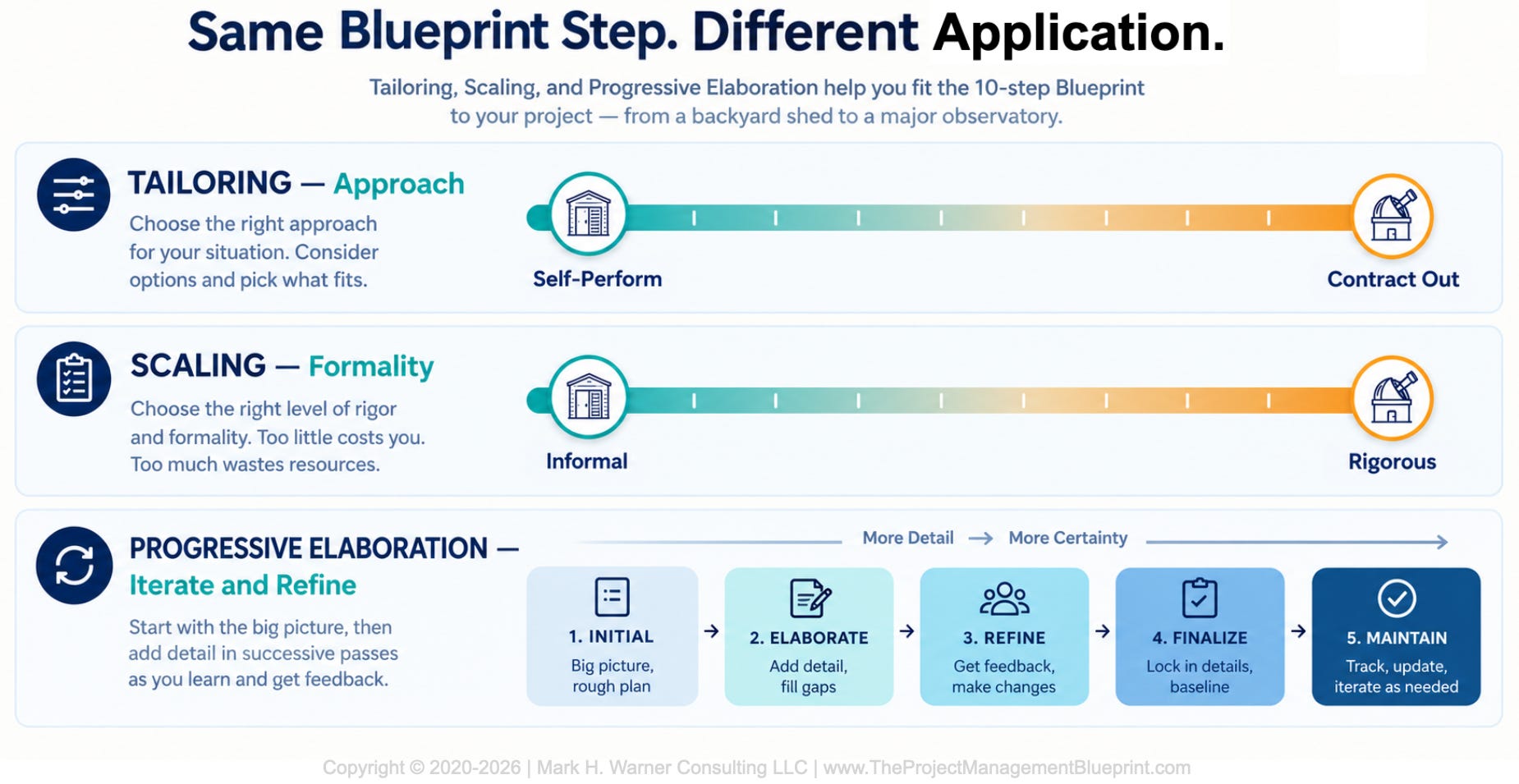
In other words, even a relatively rigid federal funding agency explicitly tells its project managers to use a 10-step framework to plan a project, but don’t implement these steps the same way every time. Fit the plans to the specifics of the individual project. And the secret to doing this is Tailoring, Scaling, and Progressive Elaboration. Let’s look a little closer at each of these:
Tailoring:
Tailoring means choosing the right approach for a given planning step. It’s a conscious, defensible selection you make based on your particular situation. It sounds obvious to select an acquisition approach based on your project’s circumstances, but many new project managers will just jump in, choose the first approach that comes to mind, and not consider other options that might be more appropriate. For example, let’s look at options for answering Step 5: how we will acquire the deliverables:
DIY Shed: For our shed project, we might immediately assume that we’ll do all the work ourselves. But after investigation, it turns out that having the local big-box hardware store do delivery and installation is relatively affordable. The benefit is they handle all the details, permits, and even assume liability. But they want an arm and a leg to do the foundations. So, we decide that we would dig and pour the foundation ourselves, then hire Home Depot to deliver and assemble the shed kit.
Telescope: For a big, federally funded project like a new observatory, there will be a myriad of federal acquisition rules that must be followed, including things like the BABA Act (Build America, Buy America) and labor rate compliance. We also need to consider how we’re going to test and accept various components, plus how we’ll assemble them. This will dictate how we split up the work. For some elements, like software, we might decide to staff up and self-perform, but other things, like large optics, will be purchased via competitively bid processes and under fixed-price contracts, and overseen by engineering contract specialists we hire.
The key to tailoring is the pause-and-consider step. Think through the pros and cons of your idea. Then solicit feedback from others. Don’t just jump at the first solution; instead, take the time to consider if the answer to each Blueprint step question makes sense in both the micro and macro sense.
Scaling:
Scaling means choosing the right level of rigor and formality for whatever approach you picked. Get this wrong in either direction and it costs you; too little formality and you can miss problems, but too much and you’re burning budget generating reports nobody really needs. For example, how this might get applied to Step 3, which is establishing and documenting the scope of deliverables:
DIY Shed: Even for a simple project like this, a work breakdown structure (WBS) is still required, but it can be “scaled” literally to just a hand-written sheet of paper. If we’re the sole key stakeholder, there is no need to go further than this. If, say, however, our significant other is part of the project, we might want to be a bit more formal to ensure there are no misunderstandings about what will and won’t be provided. And if a neighbor will contribute to the project and share space to store his tools, we may want to create a formal typed and signed-off document that formally establishes what will and won’t be built.
Telescope: For our observatory project, our WBS will have to be much more formal. It will probably need to be documented in professional project management software, formally reviewed and approved by several key stakeholders, including our funding agency, and then formally baselined and placed under configuration control. Things like our schedule, acquisitions approach(es), budget, and even risk management approaches may be tied to the WBS.
The key to scaling is finding the Goldilocks approach to implementing each step of the Blueprint. Sometimes, your stakeholders will require certain approaches and levels of formality. It’s up to you to decide if you need more or less than that.
Progressive Elaboration:
Progressive Elaboration is a process in which we iterate on our plans, starting with big-picture decisions and then adding successive levels of detail. At each pass through the plans, we typically want to get our key stakeholders to agree. Depending on the project, this iteration could be just 1 to 2 passes over the course of a weekend, or it can include dozens or even hundreds of iterative passes and take years to complete. In a sense, progressive elaboration is getting more and more detailed with our plans in a systematic process that builds fidelity in an organized manner. Rather than trying to fully detail everything on day one, we take a rough first pass through all 10 steps, get stakeholder agreement, then loop back and add detail. We repeat this however many times our specific project requires:
DIY Shed: A simple 1-2 sentence statement of our goals, followed by a hand-written list of deliverables, a rough sketch and plan, then a bit more detail once our spouse signs off, then final plans worked out with Home Depot. Simple, because anything more complex is a waste of time.
Telescope: For a project of this sophistication and scale, we will probably progress through a series of formal gates, such as Conceptual, Preliminary, and Final Design. We will also likely enlist outside experts, form advisory boards, and hold mini-reviews and check-ins along the way. Each element of the plan will gain detail and sophistication as we progress through the process. By the time we’re ready to construct, we will have a complete set of thoroughly reviewed, formally approved, and baselined plans and documents, all under configuration control and locked down. Any changes to any of the plans or expectations will then be subject to formal approval through change management processes.
The power of progressive elaboration is building a strong and stable foundation before running ahead with finer details. Get buy in at each successive pass through the Blueprint, and surprises and costly rework will be minimized.
The Bottom Line:
The benefits of Tailoring, Scaling, and Progressive Elaboration aren’t just avoiding wasted work, though it does that. It also manages everyone’s expectations along the way, ensuring no one gets blindsided late in the project by a decision or approach they never agreed to. And because stakeholders are part of the process, they feel like they were part of the decision-making, not just recipients of it. That alone makes the closeout go smoother and with fewer surprises.
Tailor the approach. Scale the formality. Elaborate progressively, with buy-in at every pass. Do those three things appropriately, and the Blueprint will fit your project like a well-tailored (and scaled) suit!