

“If it is not written down, it does not exist.” — Philippe Kruchten, Academic and Software Engineer
What is a Meeting Agenda?
At its simplest level, a meeting agenda is a roadmap for a conversation. It acts as a structured plan that outlines exactly what will happen during a specific block of time. It provides the “who, what, when, and where” of the gathering, listing the invited attendees, the time and duration, and the specific topics to be discussed. However, a truly effective agenda goes beyond just a laundry list of talking points. It serves as a governing document that sets the boundaries for the discussion, ensuring that the time spent together is focused, relevant, and productive rather than a meandering chat.
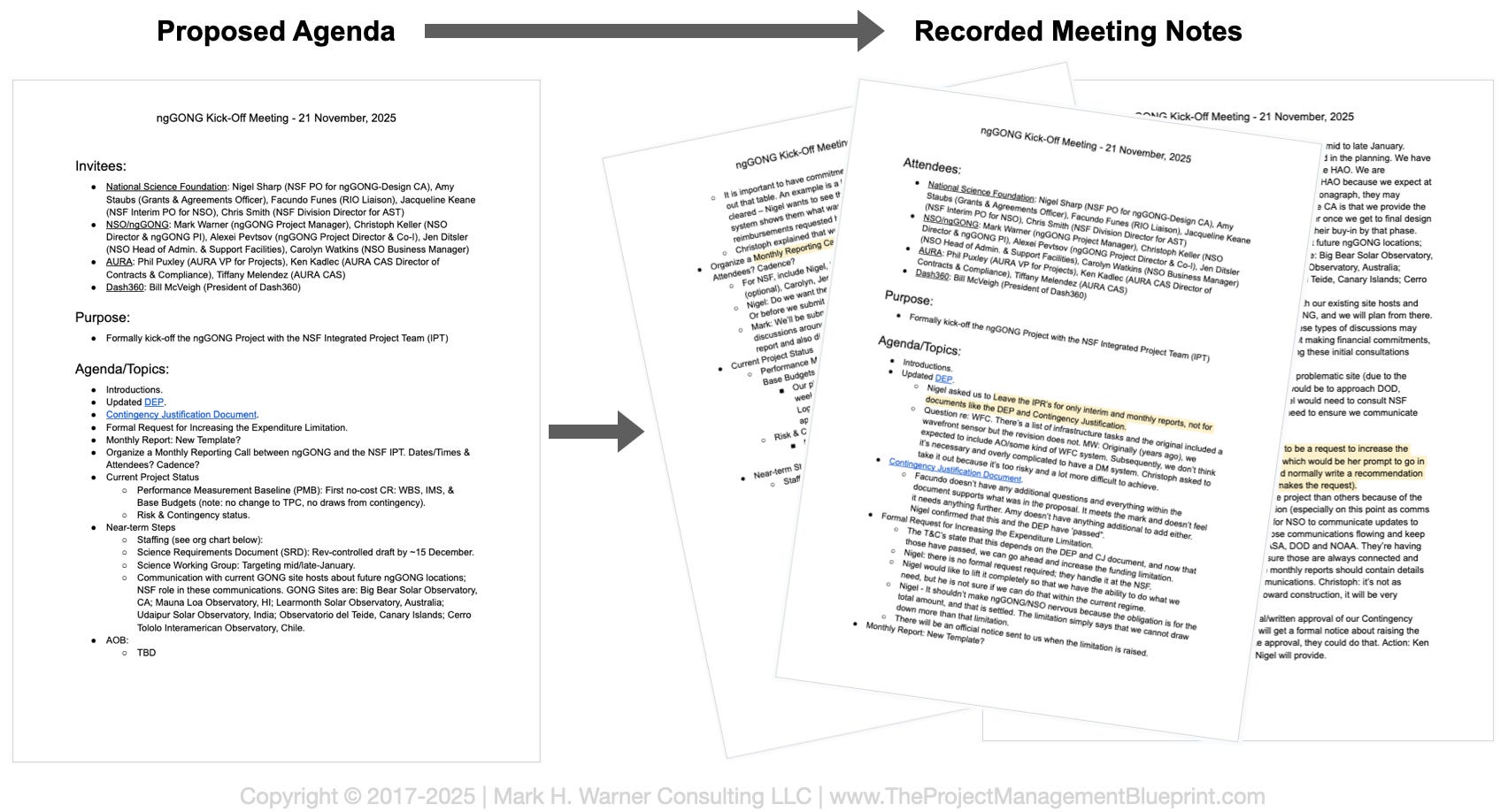
I view the agenda as a living document that transitions into the formal record of the project. Instead of having a separate document for minutes, I prefer to keep meeting notes directly within the agenda document itself. This means the file starts as a plan of action and ends as a historical record of what was discussed, what decisions were made, and who was assigned specific action items. This consolidation reduces administrative overhead and ensures that the original intent of the meeting is permanently linked to its outcomes.
Why Agendas are Important
I was taught very early in my career a simple but absolute rule: never hold a meeting without an agenda. If a meeting isn’t important enough to warrant a few minutes of planning, it isn’t important enough to attend. Agendas are critical because they manage people’s expectations. When you send an agenda in advance, you are explicitly telling stakeholders who is coming, how long you need their attention, and exactly what you intend to discuss and/or achieve. This respects their time and sets a professional tone before the meeting even begins.
Agendas serve as a shield against scope creep within the meeting itself. Without a defined list of topics, discussions often veer off into “interesting” but irrelevant territory, wasting valuable time. A formal agenda gives the meeting lead the authority to steer the conversation back to the matter at hand. It also ensures that critical topics aren’t forgotten in the heat of the moment. In serving as the foundation for the meeting notes, the agenda also provides official and technical traceability, proving that specific decisions were made and agreed upon by the relevant parties at a specific point in time.
How We’re Addressing Agendas on ngGONG
Last week, we held our first formal meeting with the National Science Foundation (NSF). This was our official Kick-off Meeting (KOM). Standard procedure dictates that a KOM happens shortly after the start of a project, but our timeline was unusual. Because most NSF personnel were furloughed due to the recent government shutdown (literally on the same day our project started), we had operated independently for the first 45 days. While the delay wasn’t ideal, the good news is that our NSF Integrated Project Team (IPT)—which includes a Program Officer, a Grants and Agreements Officer, and a Research Infrastructure Office liaison—proved to be professional, knowledgeable, and pragmatic once they were back online. Said more simply, we all just rolled with the reality of the situation the best we could.
The meeting was called relatively late, leaving us little time to prepare. Via a series of email exchanges, the Program Officer said that he wanted to cover introductions and discuss two specific documents we had already submitted: the Design Execution Plan (DEP) and our Contingency Justification Document. I took this input and created a formal agenda in Google Docs. I added a few additional topics I wanted to cover and then ran it by my internal team first for comment. I then shared the link to the document with the NSF ahead of time so they could review, prepare, and add their own additional topics as required. During the KOM itself, I led the discussion using this document, while my head of administration recorded notes in real-time. We walked through every agenda point, noted decisions, and wrapped up with an “Any Other Business” (AOB) session and a hearty thank you to the team.
How You Should Address Agendas
You should establish a standard, reusable template for your agendas and use it for every single meeting you call. On previous projects, I used Evernote for these types of things, but now prefer Google Docs because it is both shareable and collaborative, allowing attendees to see updates in real-time. That said, the tool doesn’t matter as much as the action of creating the agenda itself; you can use whatever tool fits your workflow as long as you just do it. I also recommend that your template should be simple: include a list of invited attendees, a one-line statement of the meeting’s purpose, and a numbered list of agenda topics starting with “Introductions” and ending with “AOB.” Draft this early, share it with your team for a sanity check, and then send it to your client or stakeholders well before the meeting.
Once the meeting concludes, your work isn’t done. Take the notes recorded during the session—ideally captured by someone else so you can focus on leading the discussion—and clean them up immediately while everything is fresh in your mind. Edit them for clarity and accuracy, ensuring that every decision and action item is clearly captured. Then, send the link or the document itself back to all attendees, specifying that the notes serve as the formal record of the meeting. Invite them to comment with corrections or additions. This collaborative follow-up is vital; it ensures that everyone agrees on what happened and prevents “selective memory” problems months down the road. Remember, if it’s not captured in writing, it’s like it never existed.
Bottom Line
Never host a meeting without a written agenda. It manages expectations, keeps discussions focused, and serves as the permanent record of decisions and assignments. Use a simple template, share it early, and use it to drive the meeting from start to finish. Just do it!